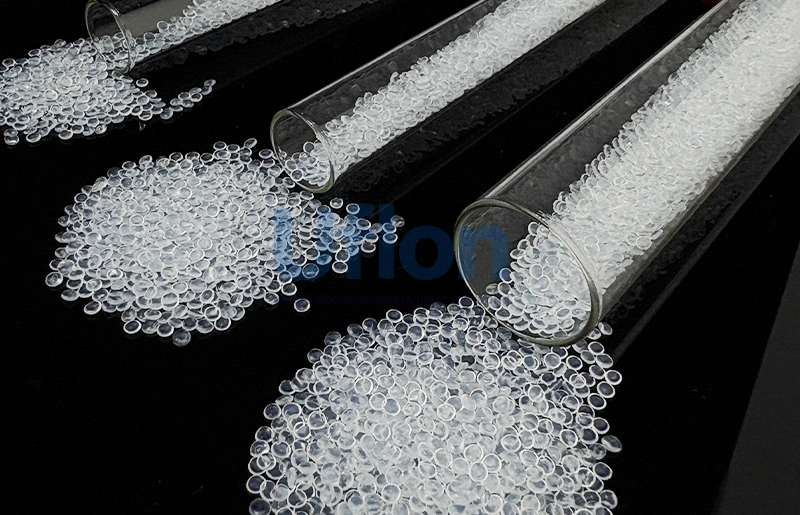

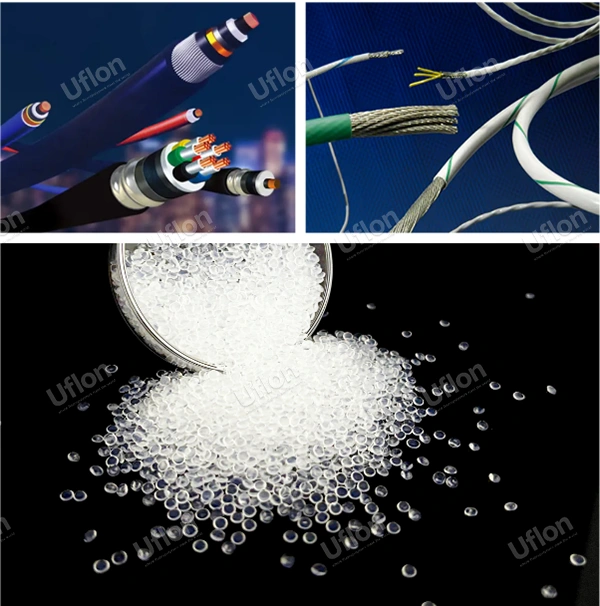
ETFE resin possesses unique hardness and abrasion resistance over a fairly wide operating temperature range. It can be melt-processed, the products made from ETFE resin exhibit outstanding toughness and excellent chemical, thermal, and electrical properties. Wires and cables are one of the largest application markets for ETFE resin, primarily used as insulation for control, signal, and communication lines.
ETFE resin is suitable for applications with high environmental requirements, such as the insulation of various cables and communication lines in transportation, aviation, chemical and nuclear plants, oil wells, and underground. ETFE's inherent lubricity helps cables navigate complex and winding paths, while its abrasion resistance ensures insulation integrity. Its resistance to burn-through under hot soldering iron and mechanical puncture are also the needed characteristics for cables.
| ITEM | UNIT | VALUE | TEST STANDARD | |
|---|---|---|---|---|
| Physical Properties |
Appearance | Translucent particle | ||
| Melting Index (MFR) | g/10min | 20-29 | ASTM D1238 | |
| Specific gravity | g/cm³ | 1.72-1.76 | ASTM D792 | |
| Melting Point | ℃ | 250-270 | ||
| Glass transition temperature | ℃ | 80 | ||
| Linear thermal expansion coefficient | 10-5/K | 11-14 | ASTM D696 | |
| Heat distortion temperature (181N) | ℃ | 63 | ASTM D7207 | |
| Thermal conductivity | W/(m・K) | 0.17 | ASTM C177 | |
| Flammability | V-0 | UL94V | ||
| Mechanical Properties |
Tensile strength | Mpa | 45 | ASTM D638 |
| Elongation | % | 380 | ASTM D638 | |
| Flexural strength | Mpa | 23 | ASTM D790 | |
| Flexural modulus | Mpa | 850 | ASTM D790 | |
| Compression modulus | Mpa | 700 | ASTM D695 | |
| Electrical Properties |
Dielectric constant | 2.5 | ASTM D150 103Hz | |
| 2.5 | ASTM D150 106Hz | |||
| Dielectric loss tangent | 0.0007 | ASTM D150 103Hz | ||
| 0.008 | ASTM D150 106 Hz |
Good melting fluidity, used to produce wire and cables, membrane structures,as well as injection moulding parts with complex structure.
100 meters northwest of Changiiafang Village Committee, Gaoging County, Zibo City, ShandongProvince
Copyright © 2025 by Zibo Uflon New Material Technology Co., Ltd. All Rights Reserveds
Privacy Policy