In architectural membrane structures, semiconductors, new energy batteries and chemical anti-corrosion and other sectors,ETFE, PVDF and ECTFE are widely adopted. All three fluoropolymers are renowned for excellent corrosion resistance, weatherability and electrical insulation properties; However, there are many failed cases caused by wrong fluoropolymer selection n practical projects.
This article would deliver an in-depth, thorough analysis of ETFE, PVDF and ECTFE. Based on five critical dimensions: molecular structure, thermal performance, mechanical properties, chemical resistance and processing characteristics.
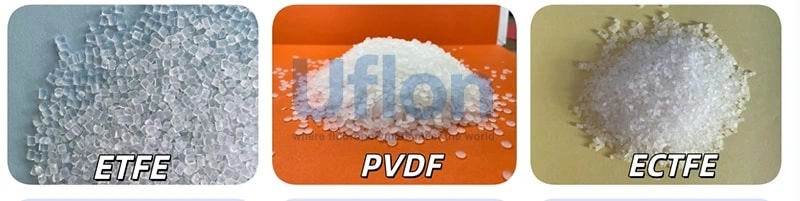
Ⅰ. Basic information
|
Material |
Structure |
Crucial difference |
|
ETFE |
Alternating copolymer of ethylene and tetrafluoroethylene |
Fluorine content approx. 59%; retains partial C-H bonds, balancing rigidity and toughness. |
|
PVDF |
Homopolymer of vinylidene fluoride |
Fluorine content approx. 59%; abundant C-H bonds, readily forms polar crystals and exhibits piezoelectricity. |
|
ECTFE |
Alternating copolymer of ethylene and chlorotrifluoroethylene |
Incorporates chlorine (Cl) atoms, which account for its extremely low gas permeability and outstanding flame retardancy. |
Ⅱ. Physical parameter Comparison
1. Thermal performance and processing
|
Index |
ETFE |
PVDF |
ECTFE |
|
Melting point |
255-280℃ |
165-172℃ |
238-242℃ |
|
Thermal decomposition temperature |
>300℃ |
>380℃ |
>300℃ |
|
Continuous operating temperature |
-80℃~+150℃ |
-50℃~+150℃ |
-30℃~+150℃ |
|
Processing temperature range |
280-330℃ |
180-260℃ |
260-285℃ |
Note: All figures above are typical reference values, with deviations expected among various grades such as injection, extrusion and filtration.
Deeper Analysis:
· PVDF has the lowest melting point among with them, relatively low energy consumption during processing; however, it softens when exposed to temperatures above 150°C.
· ECTFE has a melting point of 238°C, lower than that of ETFE. Bue due to chlorine atoms embedded in its molecular chains, it delivers distinctive thermal stability even under open flame. During processing, overheating must be strictly avoided to prevent the generation of hydrogen chloride gas.
· ETFE is ideal for large-scale extrusion and injection molding production.
2. Mechanical properties and rigidity
|
Index |
ETFE |
PVDF |
ECTFE |
|
Tensile |
40-50MPa |
40-55MPa |
45-55MPa |
|
Flexural modulus |
600-900MPa |
1300-2400MPa |
1200-2000MPa |
|
Impact resistance |
Excellent |
Good |
Superior |
Selection suggestion
√ Require high rigidity(e.g., chemical towers, supporting structures):choose PVDF
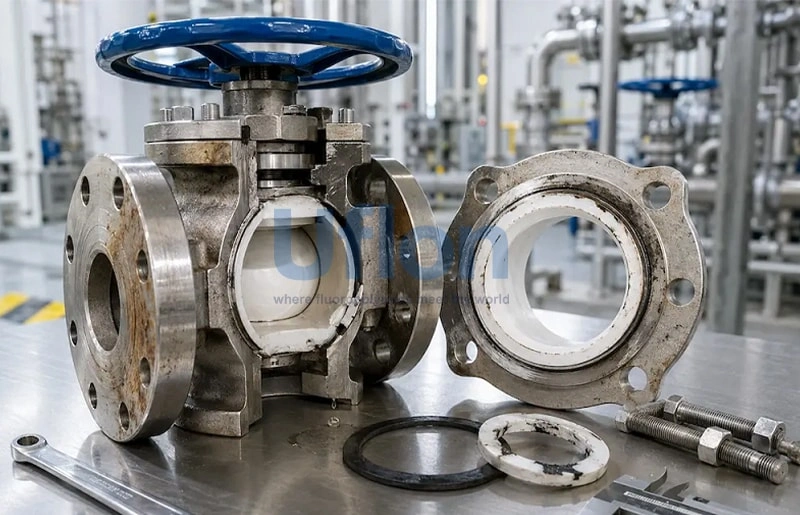
√ Require high toughness/impact resistance(e.g., pump & valve linings, wear-resistant coatings): choose ECTFE
√ Require high resilience and flexibility(e.g., inflatable membrane structures, vibration components):choose ETFE
3. Chemical Resistance & Barrier Properties (their core difference)
|
Chemical environment |
ETFE |
PVDF |
ECTFE |
|
Strong acids(H2SO4,HNO3) |
Excellent |
Excellent |
Excellent |
|
Strong alkalis(NaOH)) |
Good (Limited at high temperatures) |
Poor (Easily dehydrofluorination when pH > 12) |
Excellent (Stable over pH 1–14) |
|
Halogens / Strong oxidizing agents |
Good |
Fair |
Excellent |
|
Gas Permeability |
High |
Medium |
Extremely Low |
Professional Warning
● Critical weakness of PVDF: Despite its outstanding acid resistance, the C-H bonds in PVDF molecular chains tend to undergo elimination reactions under high-temperature strong alkaline conditions, releasing highly toxic hydrogen fluoride (HF). For this reason, PVDF is strictly prohibited for service in high-temperature strong alkali working environments.
● Unique advantage of ECTFE: The incorporation of chlorine atoms enables extremely dense packing of ECTFE molecular chains, giving it the best barrier performance against oxygen and water vapor among the three materials. It is widely applied in semiconductor exhaust piping to prevent gas leakage.
4. Flame retardancy and electrical performance
|
Index |
ETFE |
PVDF |
ECTFE |
|
limit oxygen index(LOI) |
30-31 |
44 |
52 |
|
UL94 flame retardant grade |
V-0 |
V-0 |
V-0 |
|
Dielectric constant(DK) |
2.5-2.6 |
6.0-8.0 |
2.5-2.6 |
Ⅲ. Common application scenarios of three fluoropolymers
1. Construction & Infrastructure
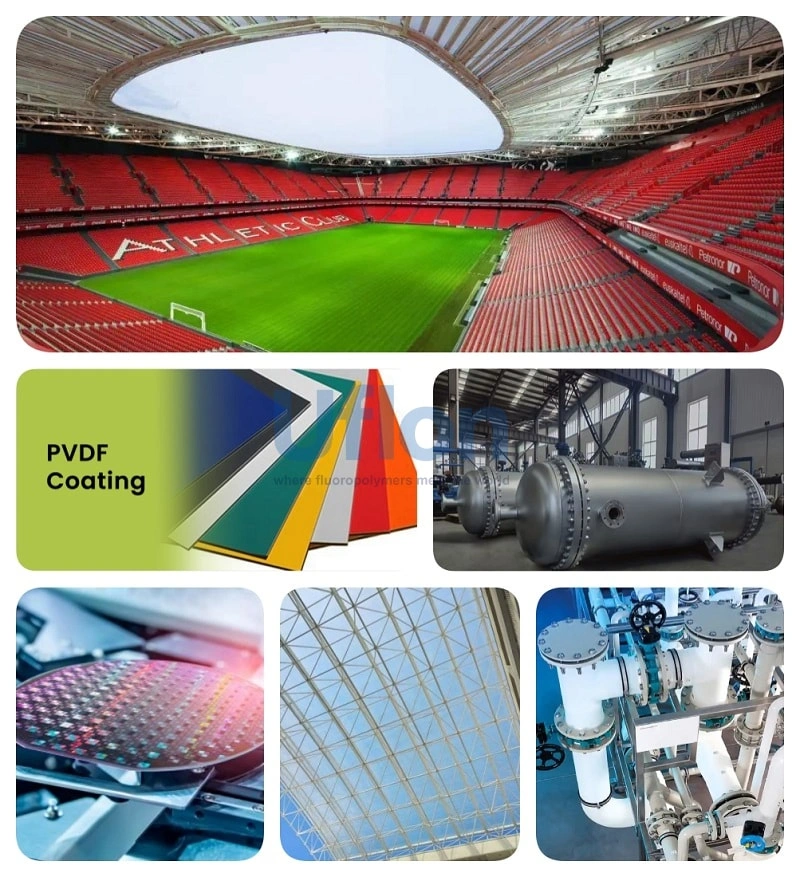
● ETFE: With high light transmittance of 95%, ultra-light weight (only 1% of glass)and weather-resistant service life of 25 to 35 years, it is the top choice of transparent membrane material for long-span buildings.
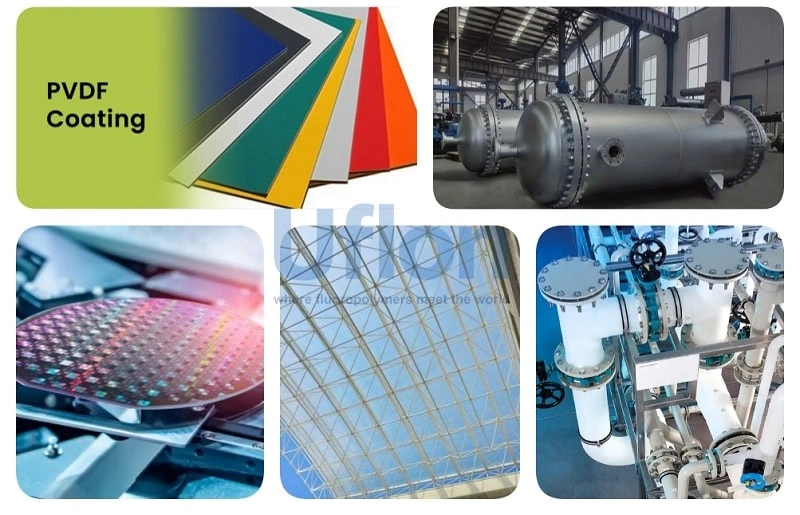
● PVDF (Cost-effectiveness): It is often used to conventional stadiums , transportation hubs and outdoor architecture. The costs far less than ETFE film,but delivers lower light transmittance. PVDF paint coating and PVDF coated glass fiber sheet are also used in construction.
● ECTFE: Rarely adopted for building structures; it is mostly utilized as anti-corrosion liners for highly corrosive projects.
2. Semiconductor and Electronics
ECTFE: Semiconductor exhaust ducts, wet cleaning equipment. Core requirements include FM 4922 certification (low flame spread / low heat release) and extremely low gas permeability, to avoid cleanroom contamination caused by process gas leakage.
ETFE: Insulation layers for high-frequency cables. It features a low dielectric constant of approximately 2.6, delivering low signal transmission loss and excellent bending resistance.
PVDF: Cathode binders for lithium-ion batteries, ultrapure water piping. Relies on its chemical inertness and high-purity grades.
3. Chemical Corrosion Resistance
● Strong acid environments: All three fluoropolymer are suitable.
● Strong alkaline environments: ECTFE is the first choice; validated PVDF is a secondary option, but temperature and pH value need strictly control.
● Negative pressure working conditions: ETFE is preferred. Its linear coefficient of thermal expansion is close to carbon steel, and it has excellent adhesion to substrates, the lining is unlikely to collapse or detach under negative pressure.
If you’re struggling to select the suitable material, welcome contact Uflon to assist.
100 meters northwest of Changiiafang Village Committee, Gaoging County, Zibo City, ShandongProvince
Copyright © 2025 by Zibo Uflon New Material Technology Co., Ltd. All Rights Reserveds
Privacy Policy