Combining superior heat resistance and chemical stability of thermosets with easy processability of thermoplastics, PEEK is the prime choice for metal replacement and lightweight solutions, widely used in high-end manufacturing industries.
However, in practical applications, we observe that the final application performance of materials often falls short of expectations. This gap is usually caused not by the material itself, but by the processing.
Based on internal technical reviews and systematic analysis, this article will be published in two parts to summarize typical processing issues in PEEK extrusion and PEEK injection molding, and provide the corresponding process optimization suggestions.
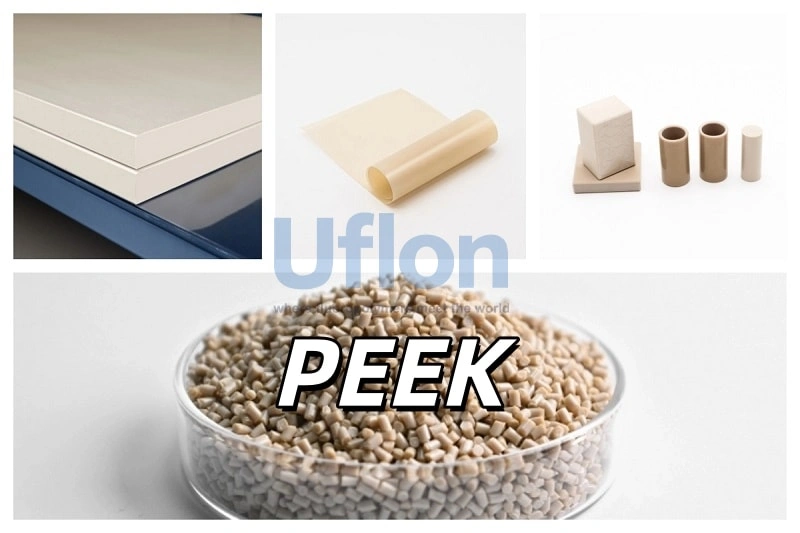
PEEK Extrusion Process
Main paints:Rough surface, high internal stress, and unstable dimensions
|
No. |
Typical problems |
Description |
Handling methods |
|
1. |
Surface Rigid Material |
The extruded profile shows local whitish, unmelted blocky areas with a rough texture, same like incompletely plasticized "raw material" embedded in the surface. |
1. Appropriately increase the barrel and die temperatures to ensure the melt reaches the optimal processing temperature range for full plasticization of PEEK. 2. Check if the runner volume of the extrusion die is excessively large; appropriately reduce the runner volume to improve shear and mixing effects of the melt within the die. |
|
2. |
Orange Peel |
The surface of the extruded profile exhibits uneven, undulating textures similar to orange peel, with poor gloss and a non-smooth feel. |
1. Raise the heating temperature/ die temperature to improve melt fluidity. 2. Ensure the die surface is clean, smooth, and preheated thoroughly before starting production. 3. Optimize the cooling rate--avoid quenching, adopt a staged cooling process. |
|
3. |
Voids / Porosity |
Small holes appear inside or near the surface of the profile, or obvious porous structures are observed in cross-sections, affecting mechanical properties and sealing performance. |
1. The PEEK raw material or plate must be thoroughly dried before forming. Drying at 150°C for more than 3 hours is recommended to remove residual moisture and volatile components. 2. Use a stepped heating process to prevent the surface layer from sealing off internal gases too quickly. 3. Increase the forming pressure to ensure the melt is fully compacted under pressure and expels internal gases. |
|
4. |
Black Spots / Black Core |
Black spots appear inside or surface of the profile. In severe cases, visible "black cores" or "black lines" appear in the cross-section, affecting appearance and material purity. |
1. Check the extruder barrel, screw, and die flow channels to eliminate dead angle. Perform polishing treatment after each production. 2. Check if the processing temperatures of the barrel and die are too high to avoid carbonization due to high-temperature degradation of PEEK. 3. Control the machine head pressure to avoid excessive pressure leading to severe material backflow and local overheating. 4. For glass fiber-reinforced grades, pay close attention to the "friction heat generation" and "heat accumulation" effects of glass fibers, and appropriately reduce the shear rate. |
|
5. |
Spiricle
|
There are Spiral-shaped streaks extending outward from the center appearing in the core of the rod, consistent with the screw rotation direction, affecting the internal uniformity and mechanical properties of the material. |
1. Add porous plates (filter plates) to convert the rotational motion of the melt into linear motion. 2. Increase the straight section length of the die to extend the steady-state section of the melt in the die, making the flow state more stable. 3. Thoroughly clean the barrel and screw, as spiricles may be caused by dirt on the inner wall contact surfaces. |
PEEK extrusion is essentially a process of matching the material properties with the process window.
In the actual production, single parameter optimization usually difficult to solve the problem,it is more necessary to make systematic adjustment based on material property, process equipment and product structure.
As a service-oriented fluoropolymer manufacturer,UFLON not only supply high quality materials, we’re more devoted to provide customers with the full-process technical support from materials selection to achieve mass production.
If you’re needing PEEK or need technical support, pls contact us today!
Conclusion
In next article we will continue to elaborate on PEEK injection molding processing.
100 meters northwest of Changiiafang Village Committee, Gaoging County, Zibo City, ShandongProvince
Copyright © 2025 by Zibo Uflon New Material Technology Co., Ltd. All Rights Reserveds
Privacy Policy