In the last article, we analyzed the common problems and processing advice for PEEK extrusion process.
Now we’ll further elaborate the PEEK injection Process.
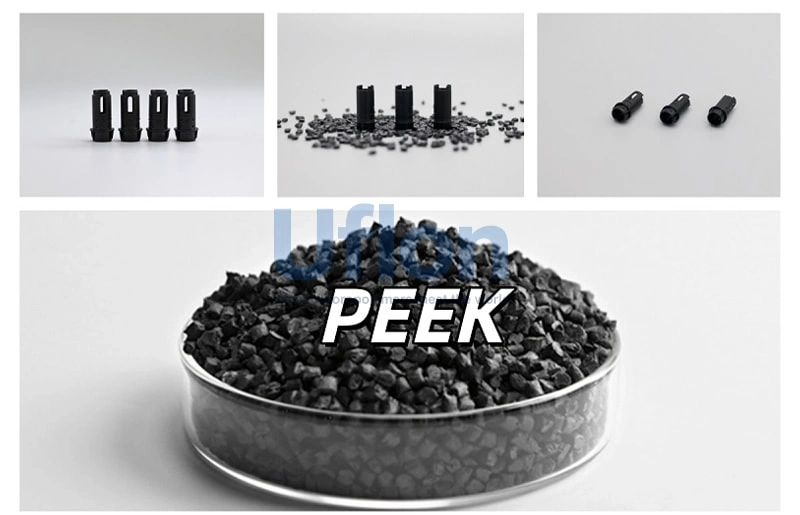
PEEK Injection Process
Main paints:black spots, flash, dimensional shrinkage, demoulding difficulty, etc.
|
No. |
Typical problems |
Description |
Handling methods |
|
1. |
Yellowing /Blackening /Black Spots |
Yellowing or black spots appear on the surface or inside the product. In severe cases, the overall color darkens, or there are local black carbonized particles |
1. Reduce barrel and runner temperatures to prevent PEEK carbonization due to excessive temperature or prolonged residence time. 2. Check if the barrel and screw are thoroughly cleaned to avoid dead corners and carbon buildup. 3. Reasonably set up material storage positions based on product weight and barrel capacity. 4. Thoroughly dry the material before use (150°C / 3h) to prevent high-temperature oxidation caused by moisture evaporation inside the screw. 5. Reduce injection speed appropriately based on product structure and gate design to avoid excessive shear heat. |
|
2. |
Sink Marks / Shrinkage Depressions |
There are obvious depressions at the thick-walled parts of the product or on the backside of the reinforcing ribs, which affect the appearance and dimensional accuracy. |
1. Increase holding pressure and extend hold time to ensure continuous feeding before the gate solidifies. 2. Adjust barrel temperature; in most cases, lowering melt temperature can reduce shrinkage. 3. Increase gate size appropriately according to product structure to achieve higher holding pressure. 4. For non-standard products with uneven wall thickness, position gates at thick-walled sections to maximize feeding pressure and time. 5. Enlarge gate dimensions to increase feeding time. |
|
3. |
Visible Weld Lines / Low Strength |
Visible lines appear at multi-gate or hole positions, where mechanical properties are significantly low and prone to fracture. |
1. Increasing the temperature of the mold to enhance the fusion property of the molten material. 2. Raise barrel temperature and injection speed to reduce melt viscosity at welding locations. 3. Improve mold venting to prevent trapped air from inhibiting fusion at welding locations. 4. Reposition gates to move weld lines to non-stressed areas. 5. If possible, add overflow wells at weld line locations, which can be trimmed after molding. |
|
4. |
Short Shots / Incomplete Filling |
The end or thin-wall sections of the product are not completely filled, with rounded edges, can’t fully formed |
1. Increase injection speed and boost pressure; high-viscosity PEEK requires high-pressure, high-speed filling. 2. Raise mold temperature to prevent premature solidification of melt at the end of the flow path. 3. Check if shot size is sufficient; increase material feed or switch to a higher-capacity injection unit. 4. Enlarge gates and runners to reduce filling resistance. 5. Improve mold venting to avoid air back pressure impeding cavity filling. |
|
5. |
Warpage / Deformation |
The product bends, twists, or has poor flatness after demolding, affecting assembly accuracy. |
1. PEEK crystallinity greatly affects warpage; ensure uniform mold temperature, with front-to-back mold temperature difference controlled within 10°C. 2. Reduce holding pressure or shorten hold time to minimize residual stress. 3. Optimize gate placement; use symmetric or multi-point gates to balance flow. 4. Extend cooling time to ensure full cooling and forming before ejection. 5. Ensure mold cooling channels are well-designed for mold temperature uniform distribution. |
PEEK injection is essentially a process of matching the material properties with the process window.
In the actual production, single parameter optimization usually difficult to solve the problem,it is more necessary to make systematic adjustment based on material property, process equipment and product structure.
As a service-oriented fluoropolymer manufacturer,UFLON not only supply high quality materials, we’re more devoted to provide customers with the full-process technical support from materials selection to achieve mass production.
If you’re needing PEEK or need technical support, pls contact us today!
100 meters northwest of Changiiafang Village Committee, Gaoging County, Zibo City, ShandongProvince
Copyright © 2025 by Zibo Uflon New Material Technology Co., Ltd. All Rights Reserveds
Privacy Policy