With the rise of the semiconductor industry, "cleanliness" is the most critical aspect, especially in wafer manufacturing, photoresist, and CMP polishing slurry pipelines. Fluoropolymers are widely recognized as representative of high-cleanliness materials.
1.What is the meaning of fluoropolymer “cleanliness”?
In the semiconductor industry, cleanliness is not as straightforward as "a clean surface". It more often refers to:
● Low ion precipitation: When the material comes into contact with ultra-pure water or chemical solvents, it hardly releases ions such as sodium, potassium, and chlorine. As we know that a tiny amount of ion contamination could form "leakage channels" in the chip circuits, causing device failure. To ensure product yield, the content of some important ions needs to be controlled at the level of ppt (trillionth) to ppb (billionth), and sometimes even more stringent.
● Low gas release from small molecules: During the molding or usage of many plastics, residual monomers, oligomers, or additives will slowly be released. For semiconductor production environments, these molecules will deposit on the surface of the wafers. Especially during the lithography process, these tiny molecular deposits can affect the uniformity of the photoresist, resulting in blurred lines or defects. In the long run, this directly affects the yield of the chips.
● Low impurity content: For instance, impurities in the fillers. If these impurities precipitate in a high-temperature and high-purity environment and deposit on the wafer. At the very least, it will lead to an increase in defect points, at worst, it will result in the complete scrapping of the entire wafer, with a significant decline in yield.

In other words, fluoropolymer cleanliness is "the ability to control contaminants". In the most stringent semiconductor workshops, any "unintentional release" from the materials could potentially be the cause of product failure.
2.Why fluoropolymer cleanliness can be so high?
● The uniqueness of the Carbon-Fluorine bond
The bond energy of the C–F bond is as high as 485 kJ/mol, which is much higher than that of C–H and C–C bonds.
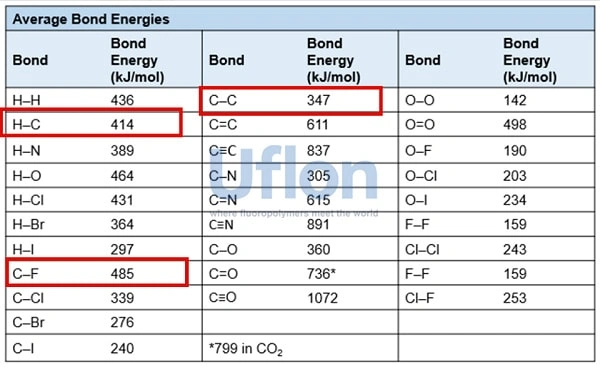
This means that the fluoropolymer chain segments are extremely difficult to break at normal temperatures, even at high temperatures, and are unlikely to produce small molecule by-products. In other words, it is inherently unlikely to "fail", and the impurities produced during decomposition are very few.
● Surface shielding effect
Although the radius of the fluorine atom is small, its electronegativity is extremely strong, and it will firmly pull the electron cloud towards itself. As a result, the outer surface of the polymer chain is almost completely "thoroughly wrapped" by the fluorine atoms.
This kind of shielding effect makes the surface of the material both hydrophobic and inert, preventing external water molecules and ions from penetrating.
So we can find that fluorine-based materials hardly absorb water (the moisture <0.01%) ,this is also the reason for the extremely low amount of ion release.
● Polarity and stability coexist
Many people might think that "fluorine atoms have strong polarity", which would make the molecular chain easily interact with the outside world? In fact, it's the opposite.
The polarity of fluorine makes the C–F bond very stable, and the highly symmetrical arrangement of fluorine atoms makes the entire chain segment exhibit "low polarity on the outer surface".
This "inner strong and outer weak" electronic property makes fluorine materials stable and not react chemically with the outside world.
3.Why fluoropolymer cleanliness can be maintained?
● High temperature resistance
The decomposition temperature of PTFE is over 400 ℃, PVDF can also withstand temperatures ranging from 150 to 170 ℃. Perfluorinated materials are more suitable for processes with high cleanliness requirements.
In semiconductor manufacturing processes, they do not "give off gas" under high-temperature conditions, ensuring extremely low release of small molecules.
● Chemical inertness
Whether sulfuric acid, hydrofluoric acid, or strong oxidants, fluorine materials do not react.
This ensures during the wet etching and cleaning processes, there are almost no residues that could contaminate the solution.
● Low-Additive
Due to the excellent properties of fluoropolymers (chemical resistance, heat resistance, wear resistance), very little additional plasticizers or antioxidants are required during the molding process.
While other polymers (such as nylon and polyester) often require a large number of additives, these additives will later migrate out, causing pollution.
Conclusion:
Why fluoropolymer cleanliness is so high? The answer is not only "it is strong", but rather the molecular logic and electronic structure behind it, which naturally makes it the cornerstone of high-end industries.
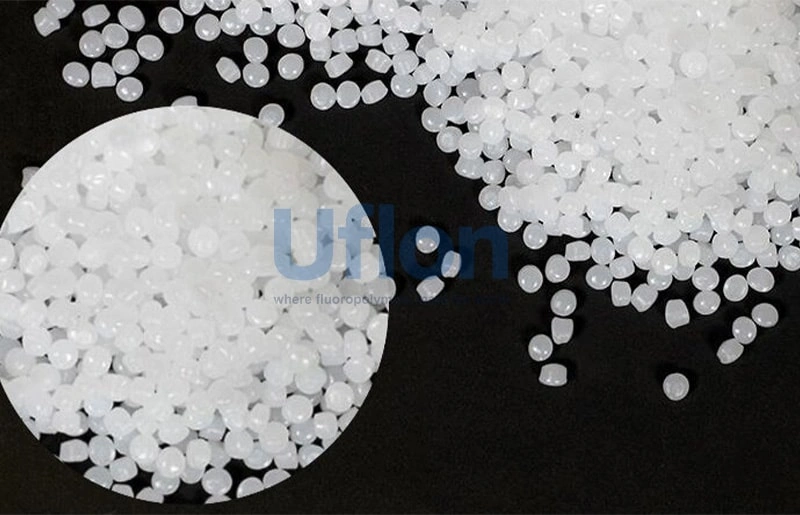
If you’re looking for high cleanliness fluoropolymer resin, welcome contact UFLON.
100 meters northwest of Changiiafang Village Committee, Gaoging County, Zibo City, ShandongProvince
Copyright © 2025 by Zibo Uflon New Material Technology Co., Ltd. All Rights Reserveds
Privacy Policy